 My dad was an engineer and scientist inventor plus several other occupations to difficult to spell or understand. He was a brilliant, warm person that every body loved. He always remembered the small details that make such a difference. He started working on designing bio-medical programs for computers, when a computer took up an entire room and you had to program punch cards for this monster to read. One of my father’s inventions was the intensive care monitoring unit which took the place of about ten nurses having to check in on open heart surgery patients. They could observe their patients twenty-four hours a day, and it was all recorded, from monitors around the hospital. Everything started in this huge room with a computer that filled it. To know exactly how his invention would work he had to participate in a lot of open heart surgeries and heart lung by-passes. I am sure that if there had just been an exam to become a heart surgeon my father would have passed with flying colors. He loved his job. He also invented things after noting those things that the nurses would complain about, that they didn’t have or didn’t work properly and dad would just come home to his little workshop and whip one up. They all ended up being successful and went on to be sold to companies like Johnson and Johnson, but because my father worked for IBM he never got any of the patents or the money because he, and what he did, belonged to the company, but he did it just to cheer up a nurse or make a big difference in how things worked in the hospital. Like I said, he loved his work. On my thirteenth birthday I took three friends to the hospital to show them a computer and to see what my dad did. Besides being impressed with the computer, he had made punch cards with all of our names on it so the computer could read it and then put it up on the monitor, and also a spread of pastries and a birthday cake. That is what I meant by little details. It was really quite exciting for the time. Next was a tour of the hospital where we were merrily greeted by everyone. I felt so proud to be his daughter. The first stop was to watch chest tubes being removed from a lady, not quite what a thirteen year old expects but it was fascinating. Every room we went into in the hospital, HAPPY BIRTHDAY BARBARA would pop up on the monitor. We were all so impressed. How did the computer know we were there? Who was pushing the buttons back in the big room with the computer in it? We had a wonderful and educational birthday followed by a trip to the old fun house in San Francisco. We were living there at that time. The only thing my father liked as much as work was a good fun park. He finally did invent the Intensive Care Monitoring Unit and it was installed in San Francisco and then New York, then on to Russia and finally to Spain which is how I ended up here. Madrid was building a state of the art new hospital called Ramon y Cajal and my father had to come to oversee the installation, but after five years here the hospital was still never completed, too many saints’ days I guess. The best part was that the invention was a huge success. In my parent’s spare time they started to tour Spain and fell in love with the country and knew they would one day retire here. Then they discovered Mojácar and my mother sent my father straight back to Madrid to pack up the house while she found something here. I think they probably found the best property and house in the area and we are still here except my father who sadly passed away about nine years ago. My father learned perfect Spanish but no one could understand him because his vocabulary was way beyond the local farmers and to make sure his grammar was correct he used to speak slowly to make sure he got it right, but they didn’t know the grammar either, as a matter of fact this is where they speak the worst Spanish in Spain. He found that a bit frustrating because in Madrid he did fairly well with all the doctors and IBMers. We were great friends and spent time together almost every day and I would help him with what he called the ooffy chores that my mother would set out for him for the day. He did all the shopping because he used to love to talk to all the people and stop and get an ice cream. They used to only sell ice cream from July to September but he finally talked one ice cream parlour into keeping it all year long. Now everyone has ice cream all year long. I miss my father very much; he had such a quick wit and fantastic sense of humor.
Saturday, 21 August 2010
Computers and Science
My dad was an engineer and scientist inventor plus several other occupations to difficult to spell or understand. He was a brilliant, warm person that every body loved. He always remembered the small details that make such a difference. He started working on designing bio-medical programs for computers, when a computer took up an entire room and you had to program punch cards for this monster to read. One of my father’s inventions was the intensive care monitoring unit which took the place of about ten nurses having to check in on open heart surgery patients. They could observe their patients twenty-four hours a day, and it was all recorded, from monitors around the hospital. Everything started in this huge room with a computer that filled it. To know exactly how his invention would work he had to participate in a lot of open heart surgeries and heart lung by-passes. I am sure that if there had just been an exam to become a heart surgeon my father would have passed with flying colors. He loved his job. He also invented things after noting those things that the nurses would complain about, that they didn’t have or didn’t work properly and dad would just come home to his little workshop and whip one up. They all ended up being successful and went on to be sold to companies like Johnson and Johnson, but because my father worked for IBM he never got any of the patents or the money because he, and what he did, belonged to the company, but he did it just to cheer up a nurse or make a big difference in how things worked in the hospital. Like I said, he loved his work. On my thirteenth birthday I took three friends to the hospital to show them a computer and to see what my dad did. Besides being impressed with the computer, he had made punch cards with all of our names on it so the computer could read it and then put it up on the monitor, and also a spread of pastries and a birthday cake. That is what I meant by little details. It was really quite exciting for the time. Next was a tour of the hospital where we were merrily greeted by everyone. I felt so proud to be his daughter. The first stop was to watch chest tubes being removed from a lady, not quite what a thirteen year old expects but it was fascinating. Every room we went into in the hospital, HAPPY BIRTHDAY BARBARA would pop up on the monitor. We were all so impressed. How did the computer know we were there? Who was pushing the buttons back in the big room with the computer in it? We had a wonderful and educational birthday followed by a trip to the old fun house in San Francisco. We were living there at that time. The only thing my father liked as much as work was a good fun park. He finally did invent the Intensive Care Monitoring Unit and it was installed in San Francisco and then New York, then on to Russia and finally to Spain which is how I ended up here. Madrid was building a state of the art new hospital called Ramon y Cajal and my father had to come to oversee the installation, but after five years here the hospital was still never completed, too many saints’ days I guess. The best part was that the invention was a huge success. In my parent’s spare time they started to tour Spain and fell in love with the country and knew they would one day retire here. Then they discovered Mojácar and my mother sent my father straight back to Madrid to pack up the house while she found something here. I think they probably found the best property and house in the area and we are still here except my father who sadly passed away about nine years ago. My father learned perfect Spanish but no one could understand him because his vocabulary was way beyond the local farmers and to make sure his grammar was correct he used to speak slowly to make sure he got it right, but they didn’t know the grammar either, as a matter of fact this is where they speak the worst Spanish in Spain. He found that a bit frustrating because in Madrid he did fairly well with all the doctors and IBMers. We were great friends and spent time together almost every day and I would help him with what he called the ooffy chores that my mother would set out for him for the day. He did all the shopping because he used to love to talk to all the people and stop and get an ice cream. They used to only sell ice cream from July to September but he finally talked one ice cream parlour into keeping it all year long. Now everyone has ice cream all year long. I miss my father very much; he had such a quick wit and fantastic sense of humor. 
Wednesday, 18 August 2010
The Unequal Struggle
We live in the smartest part of town and are surrounded by wealth, but can’t find a euro to take the bus to the shop because the car just broke down. We have already gone through the penny jar and things are looking pretty grim. We are not material people yet we are surrounded by antiques and even old things in the garden that are worth a lot of money. Yesterday my husband had to wait for the family chicken to lay her egg before he could even have breakfast. The neighbours don't help. It is a hard time for most people now and we are at least lucky we have things to sell to get by. Even though we are not getting a fraction of what the things are worth they need to go and we need the money. The bank and the phone company seem to think that if you don’t have money now you are sure to have twice as much tomorrow. I don’t know how they figure that because if I don’t have it today the chance of me  having twice as much tomorrow is ridiculous. When you do get a bit of money to pay a bill the bank won’t pay it until you pay them what you owe them first. There are certain things that we could never sell because of the sentimental value but other than that we need it to fix up the house after the fire last summer and plant new trees. We lost over five hundred that are not coming back.
My husband is being sued by some monsters who ripped off his business some years back and are now seeking fresh mischief against him. Spain has an odd and erratic justice system (ask García Lorca, or Ruiz Mateos or Judge Garzón if you don't believe me) and most people caught up in it can expect years of worry and stress.
We have slowly gotten rid of all the animals because between vet bills and food they were a luxury we couldn’t afford. We found great, loving homes for them all. It is depressing but I really don’t mind because what counts is family and I have the best, so if we have to sell a few things to get by so be it. I feel much better today because we sold a painting yesterday that paid off all of our debts and left a little to spend. If we sell a few more paintings we will be well ahead. We have a vast collection of art because Lenox has supported almost every artist to pass through Mojácar and some of them gave us a painting in return for his support and generosity. We have had an offer from a Mojaquero to buy all the Fritz paintings for a fairly good price and it would see us through for a long time but he is a malicious, corrupt man and I don’t think Fritz would want him to have the paintings plus he just ripped us off on a land deal we sold for Lenox’s cousin. We took care of Fritz his whole life, and loved him like family, now he is taking care of us and I think he would want it that way but we have to draw a limit, we would not sell one of his paintings to someone he wouldn’t approve of. It has to be someone who will love it as much as we do and is not just in it for the buck.
We would like to start a new phase of our life and leave Mojácar hopefully to live a quite life near the grandchildren where we can write and work in the garden and I can ride. Riding has improved my health so much and I know I will get better if we can just get out of here, so we don’t need the hundreds of paintings we have. We want to start fresh and just take the special things with us to start our new life. So if all this stuff that has been being collected has to go, so we can go, I think it is a good idea. Each painting has a special history to it but the history and memories will stay with us. That is one of the reasons I have started writing besides it is good therapy for me. We are not materialistic people and most of this stuff either Lenox’ parents brought over from England or the wicked step-mother bought at some point. We will keep the things with good memories attached and sell the rest to make a new life, like the Randy Newman song says “You and Me Babe”.
 having twice as much tomorrow is ridiculous. When you do get a bit of money to pay a bill the bank won’t pay it until you pay them what you owe them first. There are certain things that we could never sell because of the sentimental value but other than that we need it to fix up the house after the fire last summer and plant new trees. We lost over five hundred that are not coming back.
My husband is being sued by some monsters who ripped off his business some years back and are now seeking fresh mischief against him. Spain has an odd and erratic justice system (ask García Lorca, or Ruiz Mateos or Judge Garzón if you don't believe me) and most people caught up in it can expect years of worry and stress.
We have slowly gotten rid of all the animals because between vet bills and food they were a luxury we couldn’t afford. We found great, loving homes for them all. It is depressing but I really don’t mind because what counts is family and I have the best, so if we have to sell a few things to get by so be it. I feel much better today because we sold a painting yesterday that paid off all of our debts and left a little to spend. If we sell a few more paintings we will be well ahead. We have a vast collection of art because Lenox has supported almost every artist to pass through Mojácar and some of them gave us a painting in return for his support and generosity. We have had an offer from a Mojaquero to buy all the Fritz paintings for a fairly good price and it would see us through for a long time but he is a malicious, corrupt man and I don’t think Fritz would want him to have the paintings plus he just ripped us off on a land deal we sold for Lenox’s cousin. We took care of Fritz his whole life, and loved him like family, now he is taking care of us and I think he would want it that way but we have to draw a limit, we would not sell one of his paintings to someone he wouldn’t approve of. It has to be someone who will love it as much as we do and is not just in it for the buck.
We would like to start a new phase of our life and leave Mojácar hopefully to live a quite life near the grandchildren where we can write and work in the garden and I can ride. Riding has improved my health so much and I know I will get better if we can just get out of here, so we don’t need the hundreds of paintings we have. We want to start fresh and just take the special things with us to start our new life. So if all this stuff that has been being collected has to go, so we can go, I think it is a good idea. Each painting has a special history to it but the history and memories will stay with us. That is one of the reasons I have started writing besides it is good therapy for me. We are not materialistic people and most of this stuff either Lenox’ parents brought over from England or the wicked step-mother bought at some point. We will keep the things with good memories attached and sell the rest to make a new life, like the Randy Newman song says “You and Me Babe”.
Wednesday, 4 August 2010
Donkeys in the Old Days
 In the old days donkeys and most other animals were beasts of burden, they all had a job and if they couldn’t do it they were discarded. Donkeys never were given names or brushed or given treats by hand. There was no reason because they were there to work and not for fun or pleasure. Most of the townspeople had land high in the mountains where they would grow food for themselves and the animals and get spring-water to bring home and to deliver to the other townsfolk. It is also where they took the sheep and goats in the summer to find grass and be a bit cooler. The donkey always wore hand-woven grass baskets, two on each side, and the man would ride on the back even if the donkey was loaded to the top, while the women would hold on to the tail and be dragged up the hill. If the donkey were to get sick, home remedies were used as they were on the people that were sick. When an animal got colic, soda water with bicarbonate of soda was poured down its throat, if they had foot problems nitric acid was poured on their feet and covered with rags and an old tin-can nailed to keep it covered or it was burned. If they had lung problems, Zotal or creosote was burned in a closed stable for the donkey or person for that matter to breathe to get better. It does turn your tongue black and make you feel rather ill, but it works and the effects go away with time. For the donkey that wouldn’t move or get up, that happened a lot, a fire was set under it and in short time the donkey was on its feet and ready to go. Because of the distance between towns and the shortage of people I am afraid to say that some of the animals were sexually abused on a regular basis, which is also why there was so much incest among the families. Due no doubt to the incest, many villages have a special disability or tick, or perhaps crossed eyes, or six fingers and toes (as one entire family clan does in our own village); mild deformities or a resemblance between parents, children and cousins, so you can’t tell them apart. Soon after strangers and foreigners started to arrive all of these things slowly stopped and the treatment of animals changed for the better although they still think it is funny to give a donkey a name or feed it a carrot from your hand.
Everyone lives in apartments now and shops in a supermarket so the donkey is slowly dying out. It’s just not much use any more, they shrug. All sorts of programs exist now to try and restore the Spanish donkey. They are wonderful easy-going animals and adorable as babies. With the changes in Spain, the foreigners bought the farmland high in the mountains to make their retirement homes and the locals have no desire to return to the days of hard labor. Everything was on steep hillsides so dry-rock walls were carefully built to make terraces for growing food and building houses. The houses were also built out of dry-rock wall and some of them are still standing while the new homes are falling to pieces due to poor construction and the use of sea-sand to make cement. The dry-rock style only used mud and century plant flower poles to hold the roof. The rocks fit together so well they look like they have been carved to fit but they put them together like a puzzle and collected rocks from all around with their donkeys. There was no wood in this area. My first house and the house where I now live were built of mud and rock and still stand, having had minor adjustments and a lick of paint. There were no roads to the hillside properties - only donkey paths, as were the other abandoned farms in those days, so every rock and window frame was carried on the back of a donkey to build the houses on the beautiful hillsides that the locals abandoned and the foreigners bought for the spectacular views and large pieces of terraced land, plus spring water. Now everything is paved and we have vets and doctors, the beach is full of tiny holiday apartments, bars and discos. The peaceful life has gone in exchange for tourism. In reality, the all-year residents bring in much more money to the community than do the tourists, and they create local jobs as opposed to the tourist who only buys a drink or two before returning to their cheap hotels.
Wednesday, 2 June 2010
Where Did They Come From?
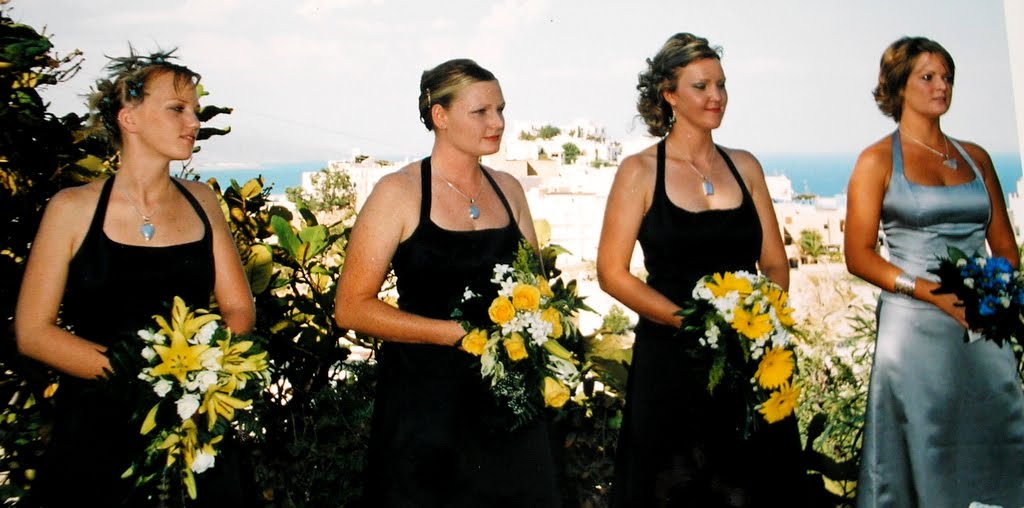 While our girls were studying in the north of Spain and in France, our spare girls still lived with us most of the time. They were like five sisters and are still today. These three extra girls came from dysfunctional British families and we looked after them for several years. They started staying with us at very early ages and just stayed most of the time. They helped with all the chores and with the animals and really having six children (five girls and a boy) was as easy as having three. I still feel like they are still mine today. Sometimes I would take them on trips with me and we all had a great time. Because they all spoke a variety of languages they would mix them up and use the first word that came into their head and because they all understood all the languages it didn’t matter because it was like their own special language. One time I took one of the girls to France with me to get Jessica, who was at a riding-school, it was a no-break twelve months a year course so they could get in their studies and their riding: they had a month on and a month off studies. We took a train to the north of Spain and then rented a car to go to France.
 On the way back we picked up Amber at Izarra, the school she was at in the Basque country. By the time we were all together in our two cabins on the train in Vitoria for the ride back across Spain the girls had tons of things to catch up on so they jabbered all day. People kept coming out of their cabins to look and listen to the girls, wondering where they came from. Besides with the combination of languages there was the combination of accents. One girl was from Manchester, England and two from America but had all grown up in Mojácar. They all had the dreadful Spanish Mojácar accent but could also speak perfect Castellano if they wanted and our girls had also picked up a bit of a northern accent. Then there was French and a few songs in Euskera (the Basque language). I could hear the people in the other cabins discussing this strange phenomenon. It was certainly nothing they had ever heard before. It is very common here in Mojácar for the children to speak four or five languages by the age of six or seven and they mix them up when they are together but when they speak to someone from a certain country they speak that language perfectly. As I have stated before it is a shame that the school and town hall never took advantage of having such a cultural diversity at their finger tips. Anyway we loved having the extra girls, which we think of as our daughters, and still do.

Tuesday, 1 June 2010
Baby Takes Lessons
 In our aviary we have Love Birds of every color and they have lots of babies all year long. They usually find a partner and stay with them for life sharing everything from building the nest to caring for the young. While the mother sits on the eggs the father brings her food and water, then, when the babies have pecked their way out of their eggs, the two parents share the feeding of the little ones. At this time, the babies are rather ugly, with bits of bristle and half-formed feathers on their tiny bodies. When the babies are ready to leave the nest, it is a lot of fun to watch them learn from their parents how to fly and eat and where to find water. They grow and learn very quickly and pretty soon they will find a partner of their own and start their own family. They are called Love Birds because once they find a mate it is for life and they like to do everything together. They are very affectionate and spend all day hugging and kissing and feeding each other. They are so close that if one dies usually within a week or so the other dies of sadness, they almost never find another mate. One day a snake got into a nest box with a mother and four babies. He ate the mother and smothered all but one baby. We had never seen anything like it because, out of character, all the birds in the aviary took turns taking care of the baby. They fed him and tried to coax him out of the nest but he did not want to leave. They started putting his food farther and farther from the entrance of the nest. When they finally got him out on to a branch they all stood in a line and tried to teach him how to use his wings. All synchronized they would stretch one wing and then the other while he watched on. He wanted to stay a baby. It looked like a Jane Fonda exercise class to watch. He would get very angry and stomp his feet and scream but the other birds were persistent. They kept moving closer and closer to the food and water trying to get him to care for himself but it was always another temper tantrum. It took him much longer to learn things than the babies with mothers even though all the birds were helping. He finally grew up and learned to do these things himself and then found a partner and started his own family. Besides being very funny to watch, I wanted to put on Jane Fonda Music for them, it is very unusual for this to happen. The father usually tries to take over both roles and is usually quiet successful, but if the baby hadn’t survived the father probably would have died of heart break. They are beautiful and wonderful birds and much more fun to watch the TV. When they are making their nests they take strips of palm branch and stick them in their wings until they can’t carry any more, they do not carry them in their beaks. They look like pretty colored porcupines. Our aviary runs the length of one side of the house so you can watch them while you clean the kitchen or from the bathroom, or of course, from the garden where you will be joined by some curious sparrows and other birds.
Dress for the Occasion
 I wish the tourists could see themselves as we see them. It is bad enough to go into the bank and see oversized men in their Speedos and women in tiny summer dresses that look like they were made for their grandchildren, but when you go to have an ice cream or coffee and have to sit in front of a large dimply lady where you see right up her dress to her privates or another woman sat down with the back of her dress stuck on the back of the chair so during your whole coffee all you can see is her back side in a g-string, not a very pleasant sight. I know we all wear T-shirts and swim suits at this time of year but they should stay on the beach or people should take more care of how they sit. It is not just the women. When a big man sits at the table in his Speedo, he leaves little to the imagination but the worst are the men that wear surfer shorts with nothing underneath and then cross their legs while they sip a cool brew. You can see right up the loose leg of the shorts and well you can imagine what you see. I have nothing against the human body, but there is a time and place for everything. I don’t feel the bank or a restaurant is quite the place for this type of attire.
Saturday, 13 March 2010
Daniel & Art

From the time Daniel was a very young child he had a great love for art and music. I am not talking about children’s songs and Dr Seuss. We owned an art museum and used to take him to all of the openings. From the time he could barely talk he found a way of telling you what he liked and how it made him feel. Once at the Madrid airport we were in a waiting room and he told me; that thing made him feel soft. I didn’t know what he was talking about so he showed me. Something I had barely noticed made a big impression on him. It was a large sculpture in the middle of the room, just white and round. You couldn’t tell what it was. As we walked around it you could see that it was two doves curled around each other and it did make you feel very warm and romantic. He noticed all of these things. On a trip to England the girls just wanted to get where we were going but Daniel had to stop and look at all of the manhole covers because they had dragons and horses and all sorts of things carved on them. He also didn’t miss the entrance to any building with a sculpture or carving. His taste in music from before he could talk was also unusual for his age; it ranged from Russian opera to Irish folk songs and a lot in between. He would go through phases where he had to listen to certain songs when he went to bed and he always had certain paintings he wanted in his room. He has maintained his appreciation of art and his taste in music has changed a bit more to fit his age and time period, but he still loves a large variety of music that most people his age have never even heard of.

Subscribe to:
Posts (Atom)
